Posts

Showing posts with the label Reading

Reading: The Life of Buddha, Part D

Image
The Buddha was convinced by Brahma to find disciples and spread his knowledge to the world, so the Buddha began looking for a worthy disciple who could grasp the complex nature of the Law and who would not keep the knowledge to himself. The Buddha's first thought was of Rudraka, the son of Rama, who he had encountered earlier in his travels. Rudraka was a good man who the Buddha believed would understand his teachings and spread them liberally throughout the land. Rudraka, however, had died 7 days earlier. The Buddha then thought of Arata Kalama, the master he briefly followed after leaving his father's kingdom. Arata Kalama was an intelligent and virtuous man who the Buddha trusted would teach others how to find Nirvana. Arata Kalama, however, had died 3 days earlier. The Buddha finally came to the decision to find his five former disciples. The disciples had left the Buddha after he gave up his practices of sever austerities. When the men were following the Buddha, ...

Reading: The Life of Buddha, Part C

Image
Siddhartha seated himself beneath the tree of knowledge and began meditating to gain the knowledge to become a Buddha. The brilliance of his focus and devotion was so intense that  it caused the demon, Mara, to see very unpleasant omens about his future. As the demon slept he dreamed about the destruction of his kingdom because of the enlightenment of the hero, Siddhartha. The hero would learn how to overcome suffering, old age, and death and would then teach his realizations to the people of the world. Once everyone in the world knew how to overcome suffering and death and reach Nirvana, Mara would lose all his followers as they ascended to the realm of the gods, and Mara's kingdom would crumble when he was left alone in his dominion. In despair, Mara explained all this to his son, Sarthavaha. Srthavaha tried to encourage his father not to act rashly and storm into a battle he could not win, but his father believed that with his vast army he could destroy the hero and prev...

Reading Notes: The Life of Buddha, Part B

Image
Old Age, Sickness and Death by Akuppa John Widham, via flickr King Suddhoda was so worried that the brahmans' prediction that his son, Prince Siddhartha, would abandon his royalty and wander as a hermit seeking truth that he cloistered his son in the palace most of his life. Siddhartha was given access to everything he could possibly desire. The king was so worried his son would want to leave that he brought him all sorts of pleasures to temp him. The king also kept any evidence of pain, unhappiness, or suffering outside of the palace walls. Because of this Siddhartha had never even seen old age, sickness or death. One day Siddhartha overhears some people talking about how spring has arrived and the flowers are blooming in the forest. The prince decides he wants to leave the palace and see the beautiful spring flowers. Even though it scares the king he cannot deprive his beloved son what he wants. To continue his son's protection from the unpleasant aspects of the ...

Reading Notes: The Life of Buddha, Part A

Image
'(Left) King Suddhodana asks brahmins to intertret the Queen's' . Credit: Wellcome Collection . CC BY Queen Maya decided to seclude herself at the top of the palace away from all ugliness and live an austere and celibate life. She had a dream on the night before the first day of spring of a six tusked, white elephant entering her womb. Then many gods sang to her. She summoned King Suddhodana to meet her in the forest outside the castle and shared what she had seen. On his way to the forest the king was overcome by anxiety that he couldn't explain, but a god called down to him to say that Queen Maya would bear him a son who seeks supreme knowledge. Maya asked the king to have his Brahmans interpret the dream to know if it was a good or bad omen. The Brahmans explain that it is indeed a good omen. They say that Maya's child will have intense compassion for every thing in the world and leave the castle to roam the earth as a monk. Finally, they say th...

Reading Notes: The Five Brothers: The Story of the Mahabharata, Part A

Image
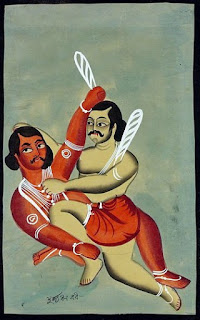
The jealousy and hatred Duryodana felt towards the Pandavas and Bima in particular started soon after the Pandavas arrived in Hastinapura. The Pandavas were stronger than all the Kauravas, and Bima, the strongest of the Pandavas, could beat all the Kauravas at once in any sport or test of physical strength. Bima used his ability to overpower the the Kauravas to bully them throughout their youth. Duryodana was predisposed to jealousy and other evil feelings because when he was born he caused a lot of destruction throughout the kingdom and the king was advised to abandon his child. So, when Duryodana met the Pandavas and found out that they were better than them at most things, he grew deeply resentful of them. Duryodana focused his attention first on Bima and looked for a way to kill the strongest brother. Duryodana came up with a plan to kill Bima. He invited the Pandavas and the Kauravas to the river and served them a feast. During the feast Duryodana served Bima poisoned food. Af...

Reading Notes: Mahabharata: Karmic Revolution, Part F

Image
Indra Draupadi - wife of the Pandavas won by Duryodhana from Yudishthir at dice chanted Krishna's name asking him to protect her from being undressed by Duryodhana Krishna made her the of her sari get eternally longer so Dushasana could never remove it when given 3 requests she asked Dhritarashtra she only asked for two, that Yudhishthira be freed from slavery and that freedom for the Pandavas and their kingdom, saying that the Pandavas did not need any other help Bhima vowed to wage war on the Kauravas and bring an end to their line while exiled asked by Draupadi to get her lotus flowers met Hanuman while looking for the flowers and was chastised for waking all the anmals could not move even Hanuman's tail brother of Hanuman Hanuman agreed to give him a boon to help in the war Duryodhana decided to get the Pandavas back for another game of dice convinced Dhritarashtra to invite the Pandavas for the game had complete control over the kingdom after...

Reading Notes: Mahabharata: Karmic Revolution, Part E

Image
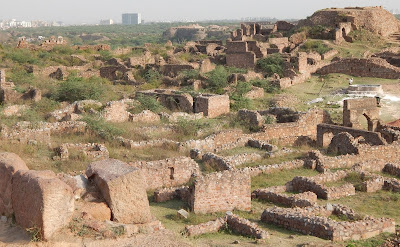
Possible ruins of Indraprastha Subhadra - Krishna's sist er Wants to marry Arjuna Abducted by Arjuna so they could marry Balarama - older brother of Krishna did not approve of Subhadra marrying Arjuna at first wanted to attack Indraprastha and save Subhadra until Krishna explained that Arjuna and Subhadra were actually in love approved of their marriage after that Draupudi - Wife of the Pandavas eventually approved of Arjuna marrying Subhadra after getting to know her and liking her refused to appear as a slave to the court, but was dragged out protected in the court by Krishna Abhimanyu - son of Arjuna and Subhadra maintained all the knowledge of war Arjuna told Subhadra while she was pregnant with him never learned all the information he needed to escape the 7th circle of the chakravyuh because his mother fell asleep while his father told her about it trained by Pradyumna, Krishna's cousin, and Arjuna Narad - sage predicted that ...

Reading Notes: Mahabharata: Karmic Revolution, Part D

Image
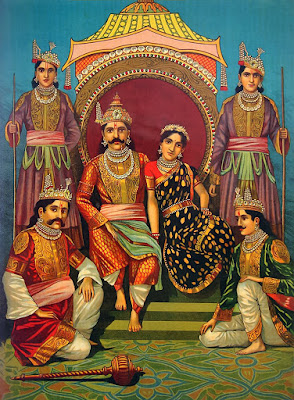
Draupadi and the Pandavas Draupadi her swayamvara was attended by many princes and brahmans, including the Pandavas and Kauravas the challenge at her swayamvara was to shoot an arrow into the eye of fish that was painted on a wheel turning above a bowl of oil without looking at anything other than the reflection of the fish in the oil none of the princes (even Duryodhan) could even lift the heavy bow provided by the king until Arjuna Arjuna successfully completed the challenge and won Draupadi's hand in marrage married all 5 of the Pandavas at once because she had prayed in a past life to have a husband with 5 virtues Karna - king of Anga attended Draupadi's swayamvara, but Draupadi refused to allow him to attempt the challenge because of the low class he was raised in was so humiliated by this that it set him on the path to cause a lot of destruction in the future Krishna - avatar of Brahma  attended Draupadi's swayamvara, but did not attempt the ch...

Reading Notes: Mahabharata: Karmic Revolution, Part C

Image
Arjuna and Karna in War via  WikiMedia Commons This week I'm continuing my viewing of Epified's retelling of the Mahabharata and taking notes on character's. I have had a lot of trouble keeping all the characters' plots straight in my mind so writing out a cheat sheet has made it much easier to understand. Karna biological son of Kunti and Suryadev , the sun god who Kunti sent down the river in a basket raised by  Adhiratha , a charioteer, and Radha had enchanted armour and golden kundals all his life that grew with him wanted to be a Kshatriya , elite warrior, and asked Drona to teach him, but Drona refused because he was not born into that class student of Parashurama excellent archer and could use very powerful celestial weapons When Karna silently withstood the pain of a scorpion sting, Parashurama became convinced he was a Kshatriya and banished him. cursed by Parashurama to forget his battle skills when he needs them most outshone Arjuna in arch...

Reading Notes: Jataka Tales, Part B

Image
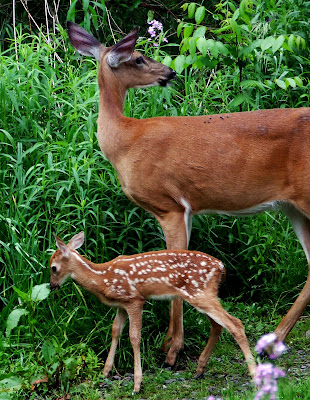
Image Source: Mother Deer and Fawn by Dave Bonta, via f lickr In "The Banyan Deer" there are two herds of deer, the Banyan Deer and the Monkey Deer, and each herd has a king. The human king of the country the deer live in loves deer meat, and hunts them regularly. However, when the king hunts he takes many townspeople with him and they are not able to do their work or complete their chores. This irritates the townspeople, and they decide to make a fenced in area that will hold all the deer so the king can easily get deer whenever he wants deer meat without taking any townspeople. Once the deer are in the park, the king or his chef come to hunt the deer regularly, but they usually end up injuring more than the one deer they kill. The two deer kings agree to a plan to minimize the loss to their herds by one herd sending a deer to be killed one day and the other the next alternating each day going forward. This system works until one day, a mother Monkey Deer with ...

Reading Notes: Jataka Tales, Part A

Image
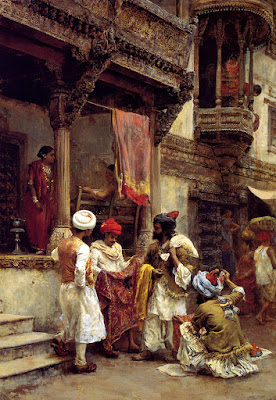
The Silk Merchants by Edwin Lord Weeks, via Wikimedia Commons In "The Merchant of Seri," there are two merchants. One is a good and honest man; the other is a greedy and dishonest one. Both merchants entered a town one day and divided the streets evenly between them. A poor old woman and her granddaughter lived in a house along one of the streets assigned to the greedy merchant. The poor woman did not think they had any money or valuable belongings even though their family was once very rich. When the greedy merchant walked by the poor woman's house her granddaughter begged her to buy something for her. When she told her granddaughter that they did not have any money or even something to barter with, the granddaughter insisted the grandmother try to trade an old bowl they never used. The old woman didn't think the bowl was anything special, she just kept it because her late husband used to eat out of it. However, she brought it to the greedy merchant and a...

Reading Notes: Krishna, Part B

Image
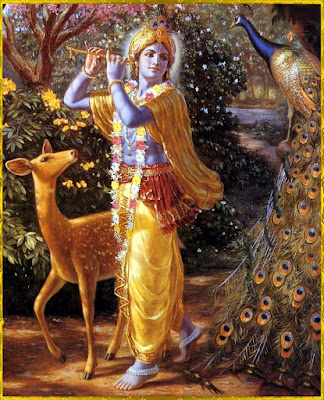
Krishna playing his flute Krishna's brother, Balram, wants to get stronger so he can kill the violent and aggressive bull Hastin with only one punch. Hastin is the root of the family tree for all the cows in Vrindavan and therefore all the cows come from him similar to how Krishna is the entire cosmos. Hastin terrorized the village and everyone there was afraid of him. In Epified's " Krishna rides Hastin ," Krishna shows Balram and the other gopis how killing the bull is unnecessary by taming the bull with kindness and generosity. Krishna vows to ride Hastin on the next full moon to demonstrate his success. Krishna implements his plan by visiting Hastin every night. During the visits Krishna plays his flute for the bull and feeds him tasty treats like jaggery , a type of cane sugar. At the beginning of the plan Krishna keeps his distance, but each night as his plan progresses he moves closer and closer to the dangerous bull. At the end of the month, on Purnima...

Reading Notes: Krishna, Part A

Image
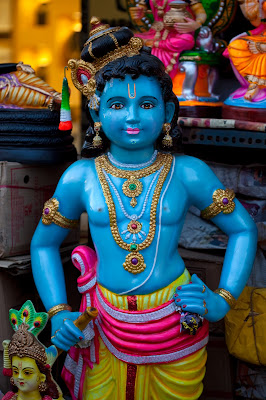
Statue of Krishna When Krishna was born his father, Vasudeva, found a way to protect Krishna from his Uncle, the king Kamsa, who had killed all of Vasudeva's other children. While the rest of the kingdom slept, Vasudeva took his son to the village of Gokul, a village of gopis, or cowhearders, and switched him with the newborn daughter of a gopi couple named Yasoda and Nanda. Vasudeva then returned to the jail where he and his wife, Devaki, were being held with the newborn gopi girl.  Krishna was raised by Yasoda and Nanda in their village. As he grew up he was loved by the villagers, but he and his friends also played pranks on them constantly. Their favorite prank was to break open the containers of butter and curd that women carried on their heads. This activity earned Krishna the nickname maakhan-chor or the butter thief. One day Krishna's older brother, Balarama, informed Yasoda that Krishna was acting up again by eating mud. When she went outside to find out ...

Reading Notes: Mahabharata: Karmic Revolution - Part B

Image
Ekalavya removing his thumb. By Ramnadayandatta Shastri Pandey [Public domain], via  Wikimedia Commons I'm continuing to summarize the characters and their interactions in the Mahabharata because I found it difficult to keep track of them all when reading the other version. Kunti was nice to and engaged the Sage Durvasa who most people were afraid of.  Durvasa gave her a mantra to summon any god Kunti tried it out on the Sun god, Suryadev, and accidentally bore his child She could not keep the child so she sent him down the river in a basket. Pandu along with his wives Madri and Kunti traveled the wilderness for a break accidentally shoots a hermit couple making love and kills them. Before dying the hermit curses Pandu so that the next time he has sex he will die. decides to stay in the forest and take up sannyasa , and Madri and Kunti stay with him died when he forced himself upon Madri who followed him to death. Pandavas - sons of Kunti and variou...

Reading Notes: Mahabharata: Karmic Revolution - Part A

Image
Bhishma taking his vow  This week while watching Mahabharata: Karmic Revolution I decided to take notes on all the characters to help me keep track of who is who going forward. Shantanu - Bhishma's father, great-grandfather of the Pandavas and Kauravas Ganga - Bhishmas's mother and goddess of the Ganges Bhishma - originally Devavrata, was the eighth Vasu cursed to be born a mortal to the goddess Ganga and Shantanu, and the only one not to be immediated drowned and freed from human life by Ganga.  Granted the ability to live as long as he wishes after taking a vow of celibacy so his father could marry Satyavati Satyavati - Daughter of a king and a nymph but adopted and raised by a fisherman.  Married Shantanu when Bhishma made his vow to relinquish his claim to the throne and to be celibate for his entire life.  Mother with Parashara of Vyasa.  Mother with Shantanu of Chitrangada and Vichitravirya.  Great-grandmother of the Pandavas and...

Reading Notes: Mahabharata, Part C

Image
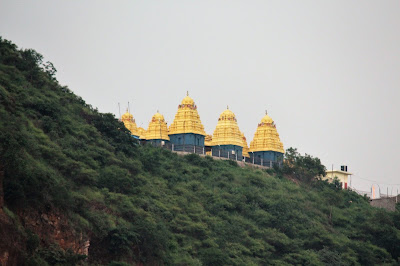
Image: Kanaka Durga Temple located where Arjuna met Shiva In "Arjuna and Shiva" Arjuna is chosen to live in austerity in the Himalayas until he sees a vision of the Great God and gains the power to defeat any enemy. This practice is a type of penance that involves meditaition or "tapasya." The place Arjuna found to conduct his penance was the Indrakeeladri hill where the Kanaka Durga Temple  is now. The hill is located in Vijayawada, Andhra Pradesh about at the midpoint of India's east coast. Arjuna began his penance by not eating anything but fruit and leaves that had already fallen to the ground. Through his meditation and devotion he was able to reduce his consumption steadily until in the fourth month he did not eat anything at all. "He was able to live on air alone." Arjuna also bathed and cleansed himself so frequently that the skin on his head was very dry and covered in lightning bolt shaped cracks. He would also hold his arms ou...

Reading Notes: Mahabharata Part B

Image
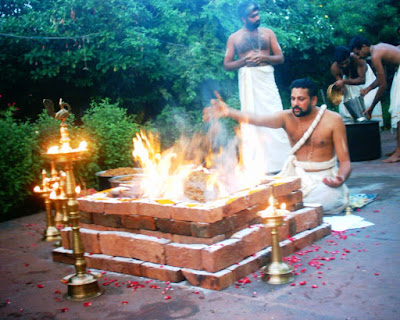
A yajna where ghee can be offered to the fire.  Image by: Srkris at English Wikipedia via Wikimedia Commons In "The Burning of the Forest" the Pandavas were celebrating Krishna's visit with a picnic by the Yamuna a large tributary of the Ganges. Draupadi, the brothers' wife, and Subhadra, Arjuna's wife and Krishna's, sister had become quite drunk, and Krishna and Arjuna told stories about their travels. The festivities are interrupted by a brahmin that looked as if he had been traveling for a long time as his clothes were ripped up and he had the traditional dreadlocks of the holy hermits. The brahmin claimed to be Agni, the fire god, and asked Krishna and Arjuna to burn the forest of Khandava for him to consume. Agni had become weakened by his twelve years of fasting, so each time he had tried to consume the forest in flames, he was not able to stop Indra, its protecting deity, from putting out the fire with a giant rain storm. Krishna and Arjuna ag...

Reading Notes: Mahabharata, Part A

Image
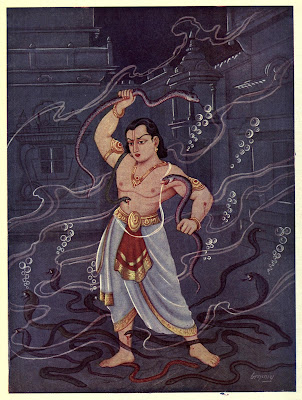
When "Bhima and the Nagas" begins the Pandavas and the Kauravas are living together in the royal palace and share a meal. Duryodhana, the eldest of the Kauravas, is a jealous and petty young man and carries a grudge against the Pandavas because they are better warriors and better liked than him and his brothers. The Pandava that Duryodhana hated more than the others was Bhima because he was the strongest. Duryodhana acted on his hatred at this meal by poisoning Bhima and dumping him bound into the Ganges. While under water Bhima is attacked and bitten by poisonous snakes called nagas. Their poison counters the poison from Duryodhana and he is able to break free from his restraints and fight off the nagas. Bhima ended up in the naga city located in the underworld, and the king of the nagas, Vasuki, wanted to meet the man that fought off so many monsters. Bhima's great-grandfather, Aryaka, was in the underworld and convinced Vasuki to give his great-grandson a g...

Reading Notes: Sita Sings the Blues, Part B

Image
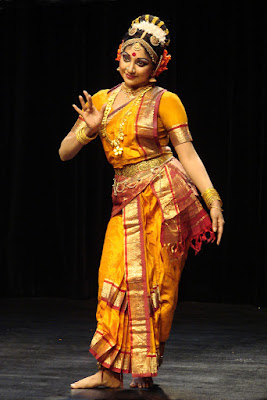
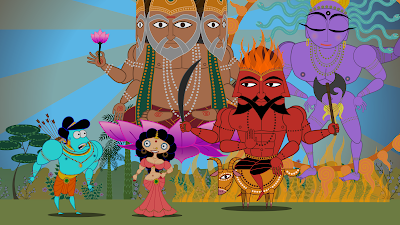
By Dalbera (https://www.flickr.com/photos/dalbera/2790476302/) [CC BY 2.0 (http://creativecommons.org/licenses/by/2.0)], via Wikimedia Commons After the Nina character receives the email from Dave, her boyfriend, breaking up with her there is an extended musical and dance sequence. There is one main female dancer that uses aspects of classical Indian dance, Bollywood dance, and Western dance. Some elements from classical Indian dance include the hand positions called mudras , and the characteristic body posture called  tribhanga composed by bending of the body into an "S" shape. There is also a segment when the Hindu gods cycle through the video replacing each other showing how they are essentially the same being. Fire is a common theme throughout the sequence as Nina's rage and grief burn after Dave's cruel breakup, and Agni, the fire god, can be seen riding his vahana the ram at various points in the sequence. The fire grows and envelopes more and mor...

Reading Notes: Sita Sings the Blues, Part A

Image
Sita emerging from the test of fire with the protection of Agni and other gods Source: Sita Sings the Blues by Nina Paley via Wikimedia Commons In Nina Paley's  Sita Sings the Blues, after  Sita asks Rama to capture the golden deer for her we see her alone in their hut singing about her love for Rama. This scene focuses on Sita's devotion to Rama which is depicted with the song "What Wouldn't I do for that Man" by Annette Hanshaw. Sita is supposed to be the ideal devoted wife in the Ramayana, and the lyrics in the song are similar to her character in the epic. The song says "love was blind to me, now it's kind to me" just like Sita never loved another man before Rama. Also she says in the song "I'll be so true to him, he'll never doubt me." Sita is always true to Rama and believes that he will trust her even after she has been held captive by Ravana. She then vows in the song to "make his troubles [her] own" li...